Why Pakistani SMEs Struggle to Scale
By Rana Khurram Ali Khan
RKA Perspiective
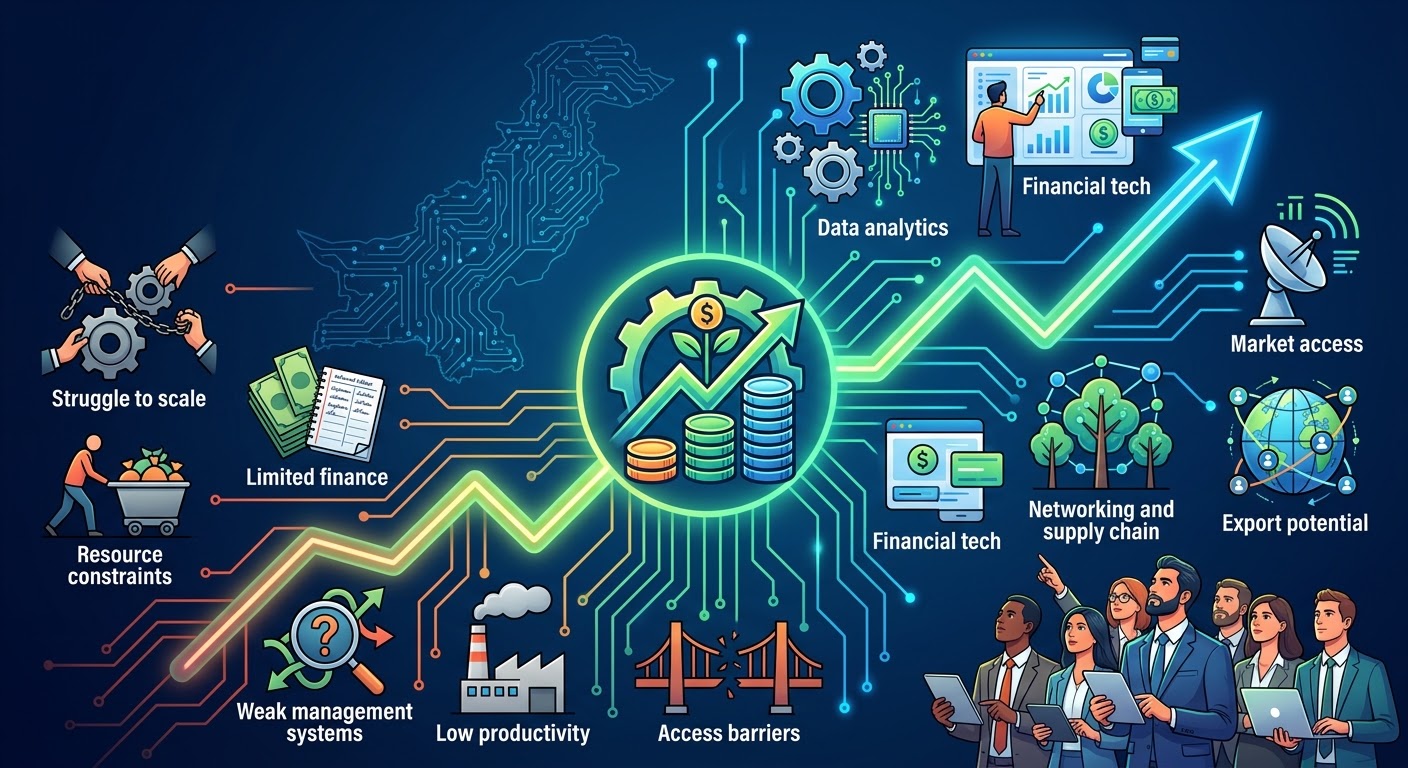
Small and medium-sized enterprises are central to Pakistan’s economic life, yet many remain small for years. They may have loyal customers, experienced owners and strong products, but growth beyond a certain point becomes difficult. The problem is rarely a single obstacle. It is usually a combination of financing constraints, weak management systems, limited technology, poor governance and resistance to formalization.
1. Access to Finance
Access to finance is an obvious challenge. Many SMEs lack audited accounts, reliable projections, collateral or a documented credit history. As a result, they depend on personal savings, family funds or expensive informal borrowing. This limits investment in machinery, inventory, marketing and talent. However, financing is not only a banking problem. Businesses also need to become finance-ready by improving records, separating personal and company transactions and presenting credible plans.
2. Technology Adoption
Technology adoption remains uneven. Some firms purchase software but do not redesign their processes or train staff. Others continue to manage inventory, sales and customer information manually. Technology creates value only when it improves visibility, speed and decision-making. Even basic digital accounting, customer management and inventory controls can significantly strengthen an SME.
3. Governance Barriers
Governance is another barrier. Decisions often remain concentrated in the owner or family. Roles are unclear, meetings are irregular and performance data is limited. Professional managers may be hired but are not given authority. When growth creates complexity, the same informal structure that worked for a small business becomes overwhelmed.
4. Market Research
Market research is frequently neglected. SMEs may expand because the owner sees an opportunity, not because demand has been tested. New branches, products or cities are entered without understanding customer segments, pricing, competition and distribution costs. Scaling a weak assumption only increases the size of the mistake.
5. Management Capacity
Management capacity also matters. Growth requires planning, budgeting, supply-chain control, human-resource systems, quality assurance and risk management. Owners cannot personally master every function. Yet many hesitate to hire professional talent because of cost or fear of losing control. This leaves the business dependent on loyal but underprepared staff.
6. Resistance to Formalization
Resistance to formalization limits partnerships and credibility. Institutional buyers, exporters, investors and banks expect contracts, compliance, documented processes and reliable reporting. An enterprise that remains informal may preserve short-term convenience but closes the door to larger opportunities.
Conclusion
Pakistani SMEs can scale when they treat growth as an organizational transformation rather than simply an increase in sales. Finance, technology, governance, market intelligence and professional management must develop together. Scaling is not doing more of the same. It is building a stronger company capable of handling more.